One of the most common questions Sea Hunt owners ask when shopping for a cover is deceptively simple: do I need a T-Top cover or a full boat cover? The answer depends on how you use your boat, where you store it, and what you're actually trying to protect.
Let's break it down so you can make the right call for your specific situation.
What a T-Top Cover Does (and Doesn't Do)
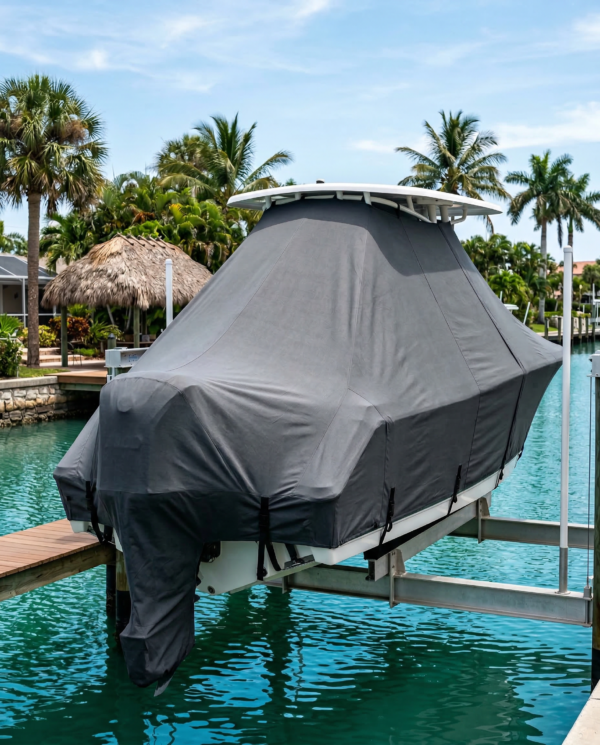
A T-Top cover is designed to enclose the area beneath the T-Top frame. It attaches to the frame itself and creates a sealed enclosure that protects the helm station, electronics, and the immediate cockpit area from rain, sun, and debris.
On a boat like the Sea Hunt 290 T-Top, a dedicated T-Top cover protects the most expensive and vulnerable area of the boat—the helm console, GPS/fishfinder screens, and throttle controls. These are the components most susceptible to UV degradation and moisture damage, and they're also the most expensive to replace.
What a T-Top cover doesn't do is protect the bow, the gunwales, or any area outside the T-Top footprint. Your bow cushions, rod holders, livewells, and transom are still exposed.
What a Full Boat Cover Does
A full boat cover wraps the entire vessel from bow to stern. It protects everything—gelcoat, upholstery, hardware, electronics, the works. For boats stored outdoors on a trailer or in an open slip, a full cover provides total protection.
For the Sea Hunt 255 Ultra T-Top, a full cover is particularly valuable because the boat's expansive deck layout means more surface area is exposed to the elements. The 255's forward seating area and wide beam create a large footprint that catches everything from pine pollen to salt spray.
The Decision Framework
Here's how to think about which cover you need:
Choose a T-Top cover if: you keep your boat in a covered slip or under a roof, you use the boat frequently (weekly or more) and want quick-on/quick-off protection for the helm area, or you already have a full cover but want additional daily protection for your electronics when docked.
Choose a full boat cover if: you store outdoors on a trailer or in an open marina slip, you live in an area with heavy UV exposure, frequent rain, or salt air, you're storing the boat for the off-season, or you want maximum resale value protection.
Get both if: you're serious about preservation. Many Sea Hunt owners run a T-Top cover for day-to-day dock protection and a full cover for extended storage. It's the belt-and-suspenders approach, and it works.
Center Console Owners: A Third Option
If your Sea Hunt doesn't have a T-Top—like the 188 center console —a full boat cover is your primary protection. Without a T-Top frame to mount a partial cover to, the full cover is the only option that provides comprehensive protection. The good news is that center console covers for boats without T-Tops tend to be easier to install and remove since there's no frame to work around.
Sizing Matters More Than You Think
Here's the part most people get wrong: they buy a cover based on their boat's length and assume it'll fit. But two 19-foot boats can have dramatically different beam widths, console heights, and hardware configurations. The 196 Ultra T-Top and a comparably sized boat from another manufacturer might share a length spec but have completely different cover requirements because of the T-Top frame dimensions, console profile, and gunwale height.
That's why model-specific covers outperform generic options every time. When the cover is patterned for your exact hull, every zipper, snap, and strap lands exactly where it should.
Whatever you choose—T-Top cover, full cover, or both—make sure it's built for your specific Sea Hunt model. Your boat was made with purpose. Your cover should be too.